Ashok Mandap

One of the most fascinating and ornately decorated rooms of Rashtrapati Bhavan is the Ashok Mandap. Interestingly, this expansive and extravagant artistic room is used for important ceremonial functions at the Bhavan. This room served the purpose of the Ball room in earlier times. The Ashok Mandap is used for presentation of credentials by Heads of Missions of foreign countries and as a formal place of introductions for the visiting and Indian delegations prior to the commencement of the State Banquets hosted by the President of India.

Guest Wing

The Guest Wing, also referred to as the South West Wing of the Rashtrapati Bhavan, consists of three floors, where the first floor is specially reserved for hosting the Heads of State, their consorts and senior members of the delegation. Its two main suites, Dwarka and Nalanda, the erstwhile Irwin and Reading Suites respectively, have accommodated Heads of States, Kings, Queens and other important dignitaries.

Guest Wing

Grand Stairs

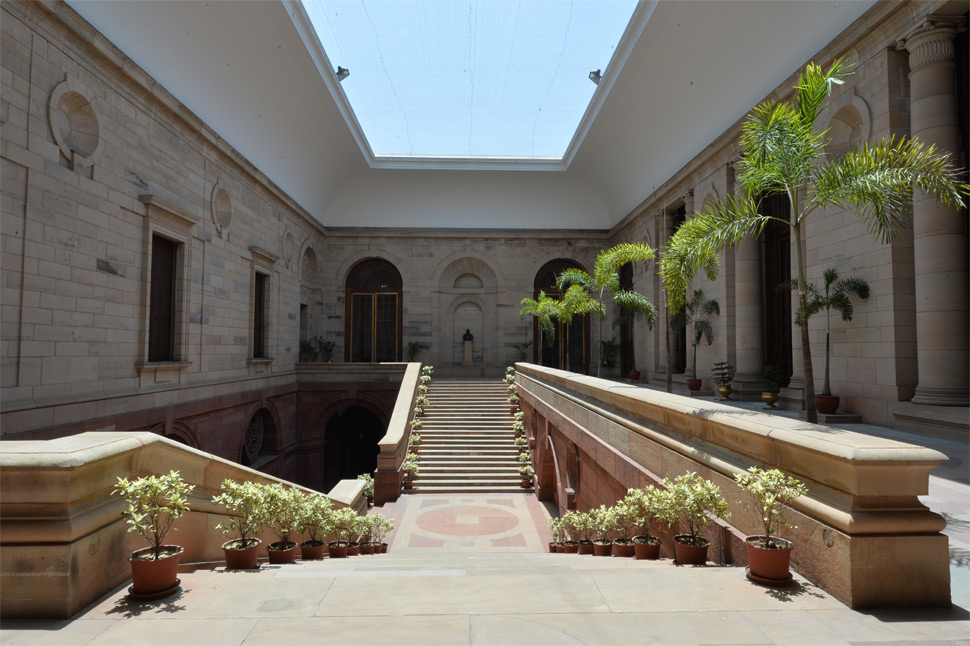
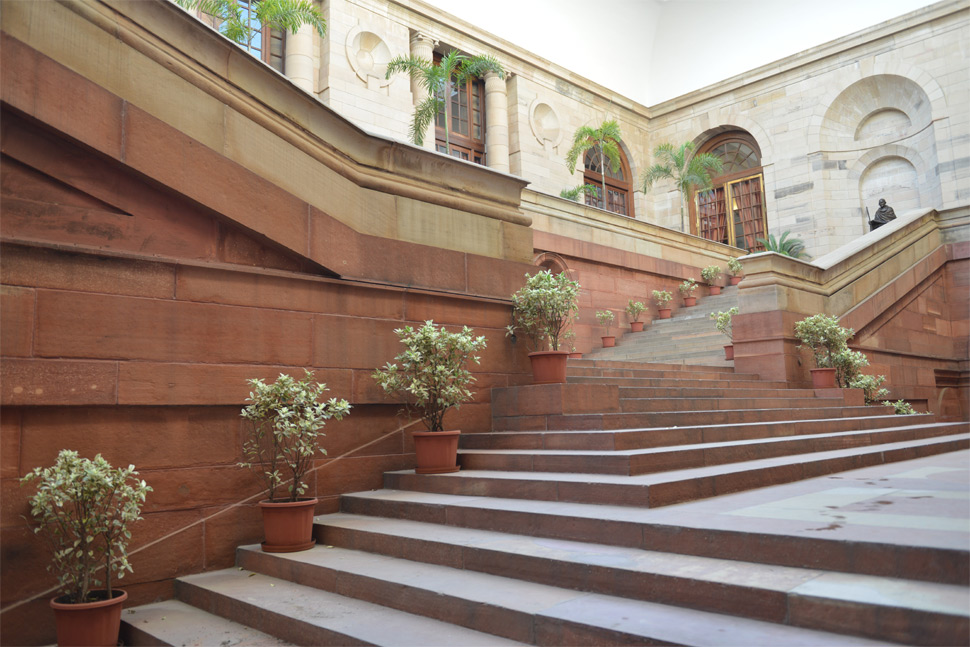
The approach to the Banquet Hall is through Grand Stairs. Made in sandstone and grand in scale, measuring one hundred eleven feet in length and fifty three feet in its width, these stairs lead to the Banquet Hall at one end and to the Ashok Mandap on the other.

Grand Stairs

crossing these stairs

Damodar (Upper Loggia)

Damodar, erstwhile known as the Upper Loggia and West Garden Loggia, lies between the Banquet Hall and the Ashok Mandap, overlooking the Grand Staircase on one side and the Amrit Udyan on the other. This room is used mostly as a space to serve tea and refreshments after functions that are hosted in the Ganatantra Mandap.

Ganatantra Mandap

Brahmputra (Banquet Hall)

The Banquet Hall, also known as the State Dining Room, hosts a wealth of beautiful detail. This room which is 104 feet long, 34 feet wide and 35 feet high overlooks the Amrit Udyan on one side. Burmese teak paneling decorates the walls of the Banquet Hall while the floors are patterned in grey Kota stone and white Makrana marble. One can notice the silent bell motifs, carved in wood, over the fluted projecting columns, the same as are placed above the Tuscan pillars of the Forecourt.

Reception

Entry to the Reception of Rashtrapati Bhavan mansion is through the Forecourt. As the visitors step inside the building of Rashtrapati Bhavan, they are greeted by a life size oil on canvas painting of the Father of the Nation, Mahatma Gandhi.

Reception of Rashtrapati Bhavan

Mahatma Gandhi

Rampurva Bull

Ashokan Pillars are the most celebrated example of Mauryan Art. Rashtrapati Bhavan houses the magnificent third century B.C. sandstone capital of the Ashokan Pillar known as the Rampurva Bull. It gets the name from the site of its discovery, Rampurva in Bihar. The Rampurva Bull is mounted on a pedestal between the central pillars at the Forecourt entrance of the Rashtrapati Bhavan.

Rampurva Bull

Tuscan Pillars

The Tuscan pillars of the Forecourt are a reminder of stateliness, grandeur and symmetry of the architecture of Rashtrapati Bhavan. These twenty strong pillars rest on the front verandah of the Rashtrapati Bhavan, twelve in front while eight behind them. They are influenced by the Tuscan order of architecture of the renaissance period.

Tuscan pillars

Iron Gate

The majestic gates of Rashtrapati Bhavan are a work of art in themselves. Having a width of six metres, these twenty-six feet wrought iron gates mark the boundary of the presidential palace as a part of the longer grille that runs from Gate No. 2 on the southern side till the northern most end of Rashtrapati Bhavan and is at a height of fourteen feet. The grille is perched on a two feet stone base, and gives an overall impression of an intricate black lace that has floral synthesis along with spiked uprights.

Jaipur Column

The Jaipur Column stands at a height of one hundred and forty five feet on the Rashtrapati Bhavan Forecourt, at an approximate distance of five hundred and fifty five feet from the main gate. Designed by Sir Edwin Lutyens and sponsored by Maharaja Madho Singh of Jaipur, the Jaipur Column was built to celebrate the transfer of the capital from Calcutta to Delhi and as a token of allegiance of the princely state of Jaipur to the British Crown.

Jaipur Column